LEO as a backup: business continuity for corporate offices
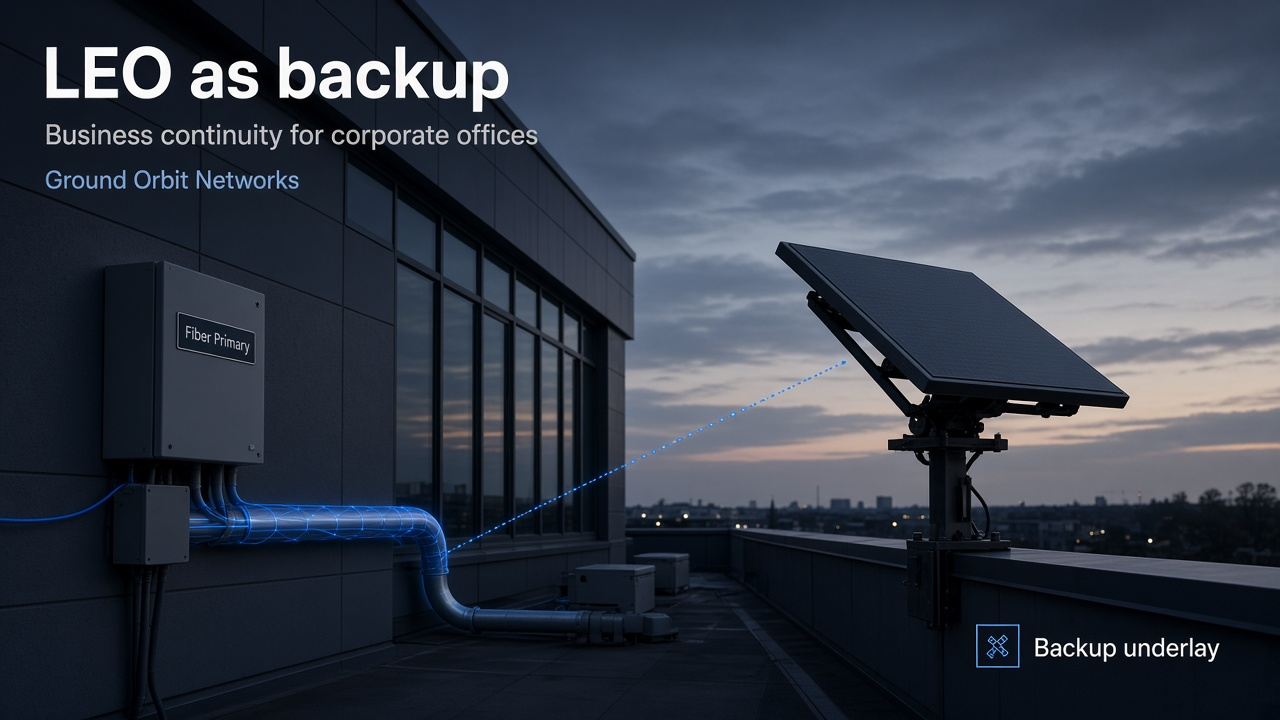
Most corporate offices still treat the primary circuit as the network. Fiber or carrier ethernet carries production traffic. A second carrier circuit is the “backup.” When both share a duct, a building handoff, or a regional outage, the office discovers that two invoices did not buy two independent paths.
Low Earth orbit (LEO) satellite internet (such as Starlink) changes that math for many organizations. A LEO path does not share the same last-mile plant as your fiber. Used deliberately as a backup, it becomes part of a continuity design you can operate.
Ground Orbit Networks helps you add that LEO backup into the office continuity plan: sized for the applications that must survive a fiber event, failed over or bonded with other backup underlays when the design calls for it, and operated day two so continuity is rehearsed capability with a clear day-two owner.
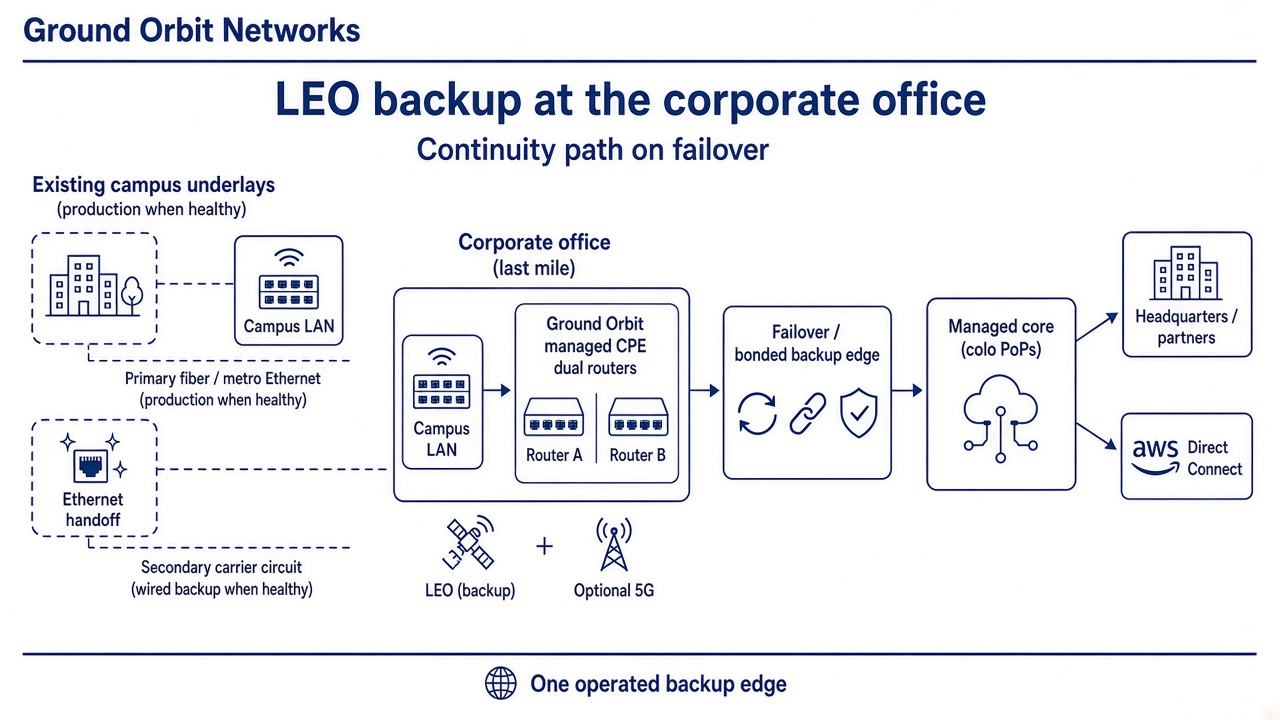
At a corporate or branch office, the site sits on the managed path as last mile. LEO is a backup underlay at that office. Headquarters attach stays as designed.
The problem: continuity that still shares a failure domain
What “backup” usually means on a campus
A typical corporate WAN continuity stack looks like this:
- Primary: fiber or metro Ethernet into the building.
- Secondary: a second carrier circuit, often from a different brand that still rides similar civil infrastructure near the site.
- Tertiary (if any): cellular or a best-effort internet circuit that was never tested under production load.
On paper that is diversity. In practice, the office still goes dark when:
- A building cut or provider POP event hits both wired paths.
- The “backup” circuit was never sized or routed for the applications that must stay up.
- Failover is a manual change someone makes after users are already offline.
- Security and segmentation on the backup path were never finished, so IT refuses to fail over.
Continuity of business is reachable headquarters applications, identity, voice, and cloud attach when the primary underlay is gone, with a clear owner and a tested cutover.
Why LEO fits as a backup
LEO is a strong candidate as a backup at corporate and regional offices because:
| Continuity need | What LEO contributes |
|---|---|
| Different failure domain | Space segment and antenna path are independent of the building’s fiber lateral and many metro cuts |
| Fast stand-up | Terminal and service can often be placed where a second fiber build would take months |
| Geographic reach | Useful for offices and campuses where diverse fiber is scarce or delayed |
| Capacity for real work | Modern LEO can carry more than a token “keep the lights on” pipe when the design sizes it for the apps that must survive |
Weather, obstruction, and contention still limit LEO as a universal primary replacement. The design question is whether LEO sits in the continuity plan as a managed backup path with a clear owner.
What breaks when LEO is DIY backup
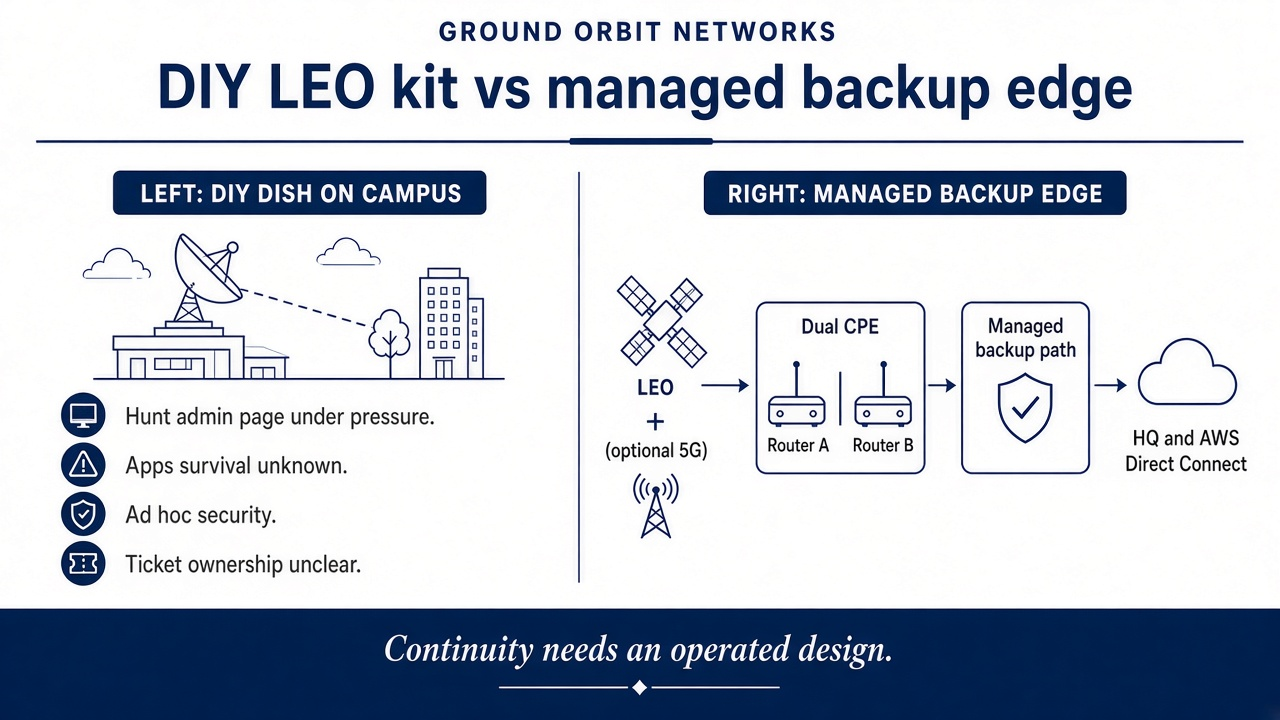
Organizations that “just buy a LEO terminal for the office” often stop at the kit. That leaves continuity gaps:
- No tested failover into the corporate LAN and security stack.
- No bonding or policy with the primary and secondary wired paths, so LEO sits unused until someone remembers the password.
- No path to private cloud and HQ that matches production. Public internet breakout is all that remains.
- No day-two owner. When the terminal needs a firmware window or the path flaps, the ticket has nowhere to go.
Business continuity needs an operated design with day-two ownership and tested failover.
Solution overview: make LEO part of the continuity plan
Treat LEO like any other production underlay you would trust during a declared event: inventorial, tested, monitored, and owned.
What changes when Ground Orbit runs the LEO backup role:
- Capacity follows the continuity list. Ground Orbit sizes LEO against identity, voice, enterprise applications such as ERP (finance, HR, and supply-chain systems), and the other flows that must survive a primary outage.
- Failover is rehearsed. Policy moves continuity traffic onto LEO (and onto 5G when the inventory adds it) before users discover the fiber is gone.
- Backup reaches the same destinations as production intent. Headquarters, partners, and AWS Direct Connect stay in scope when you fail over.
- IT stays on the business response. Ground Orbit operates the backup path. Your team runs applications, campus LAN, and the continuity playbook.
A modernized backup path: security built in, operations seamless
Adding LEO as a backup through Ground Orbit is also a chance to modernize how the office network fails over.
Simplified security model, with security built in. Continuity traffic rides Ground Orbit managed CPE into a managed backup edge. Segmentation and encryption follow the model you approve in design. Single-tenant or multi-tenant isolation is available when the design requires it. On failover, AWS Direct Connect stays in the same operated path. You get one security posture for the backup role on an operated path.
Seamless operations. Ground Orbit runs day-two on the LEO backup path: policy, monitoring, middle mile, and cloud attach as scoped. Your operators run the continuity plan (which users, which apps, which declarations). Failover is rehearsed capability. Satellite path work stays with the managed backup role during an event.
A modernized network at the office. Dual CPE by default, LEO (and optional 5G) into the managed edge, and a single operated path through colo PoPs to headquarters and private cloud. The office keeps its last-mile role. The backup underlay joins a managed multi-transport design you can inventory, test, and operate with the rest of the environment.
Architecture at a glance
| When fiber fails | DIY LEO on campus | With Ground Orbit on the backup role |
|---|---|---|
| Who finds the path | Someone hunts for the dish admin page under pressure | Continuity traffic fails onto the managed backup edge; dual CPE by default for router redundancy |
| Which apps survive | Unknown until users complain | Continuity inventory locked before the event: identity, voice, enterprise apps, and the rest of the must-stay-up list |
| Can IT trust the backup? | Ad hoc NAT and split tunnels; security often unfinished | Backup rides the same operated segmentation and encryption model you approved in design |
| Who owns the ticket | Facilities bought the kit; network owns the outage | Ground Orbit runs day-two on the backup path; you run the business continuity response |
Offices that need stricter isolation can run single-tenant; otherwise multi-tenant isolation keeps customers in separate Layer 2 / Layer 3 contexts on the managed path.
For how Ground Orbit runs many transports as one footprint-wide path, see One path across many transports. This post stays on corporate and organizational offices adding LEO as a backup for continuity of business.
Benefits for organizations and corporate offices
| Benefit | What it means in practice |
|---|---|
| Independent underlay | LEO backup does not share the same fiber lateral as the primary campus circuit |
| Faster path to diversity | Add backup capacity where a second fiber build is slow or unavailable |
| Continuity-scoped capacity | Size the LEO path for the apps that must survive |
| Simplified security, built in | One operated segmentation and encryption model on the backup edge; single-tenant or multi-tenant isolation when the design requires it |
| Seamless operations | Ground Orbit runs day-two and path tickets on the backup edge; your staff execute the business continuity response |
| Modernized, operated failover | Dual CPE, managed multi-transport edge, monitoring, and rehearsed policy into headquarters and private cloud |
| One continuity path and one bill | Managed LEO backup role for the offices in scope, with operated failover |
Conclusion / next steps
Primary fiber will fail. A second carrier circuit that shares the same civil path can fail with it. LEO gives many corporate and organizational offices a practical backup underlay with a different failure domain when the path is designed, tested, and operated as backup.
Ground Orbit Networks adds that LEO role at the office: you connect continuity LAN into Ground Orbit provided routers; Ground Orbit operates the backup underlay, failover policy, encryption, middle mile, and day-two path work through to headquarters and cloud. You get a simplified security model with security built in, seamless operations on the backup path, and a modernized network at the office edge. That is how you move from “we should get LEO someday” to established continuity of business.
Contact us to discuss your use case: brianlauer@groundorbitnetworks.com · groundorbitnetworks.com